

What Chefs Actually Store in Their Sub-Zero – And How
Open a professional chef’s refrigerator and you will notice something immediately: everything has a place. Dairy occupies one zone. Proteins another. Prepared mise en place sits at eye level. Aromatics are grouped separately from delicate greens. Nothing is random. Nothing is shoved to the back and forgotten.
This is not obsessive neatness. It is functional necessity. In a professional kitchen, disorganisation means wasted time, spoiled ingredients, and compromised dishes. The refrigerator is not storage. It is a workspace. And chefs treat it accordingly.
When a chef chooses a Sub-Zero for their home kitchen, the same principles apply. Here is how they organise it, and why these habits are worth adopting even if you are not cooking professionally.
Zone by Use Case, Not by Category
Most people organise refrigerators by food type. Vegetables go in the crisper drawer. Dairy on the door. Leftovers wherever there is space. This approach fails because it ignores how food is actually used.
Chefs organise by workflow. The top shelf – the coldest, most stable zone in a Sub-Zero – holds ingredients for tonight’s dinner. Proteins that need to stay at precise temperatures. Pre-portioned mise en place. Sauces ready to finish. These are high-turnover items that get accessed multiple times per day, so they sit front and centre where they are easy to see and retrieve.
The middle shelves hold ingredients for the next two to three days. Marinating meats. Stocks and broths. Par-cooked components waiting to be finished. This is the staging area – not immediate, but close enough that nothing gets forgotten.
Lower shelves and drawers hold longer-term storage. Whole vegetables. Bulk dairy. Ingredients bought for the weekend but not needed until Friday. These zones operate on a slower rotation, and their position reflects that.
This system works because it mirrors how cooking actually happens. You open the fridge and immediately see what is ready to use. Nothing requires excavation. Nothing gets buried and forgotten.
Temperature Zones Matter More Than You Think
A Sub-Zero refrigerator is not uniformly cold. Different zones naturally run at slightly different temperatures, and chefs exploit this.
Top shelves (coldest): 2°C-3°C. This is where raw proteins live. Fish that needs to stay just above freezing. Meat for tartare or carpaccio. Fresh seafood. Anything that spoils quickly or requires precise cold.
Middle shelves (standard cold): 3°C-4°C. Dairy, eggs, cooked proteins, prepared sauces. This is the workhorse zone. Stable, accessible, and appropriate for most ingredients.
Door shelves (slightly warmer): 5°C-7°C. Condiments, pickles, butter, soft cheeses. These ingredients do not need aggressive cold and often perform better at slightly higher temperatures. Butter stays spreadable. Brie stays creamy. Mustard and preserves hold their flavour better without being over-chilled.
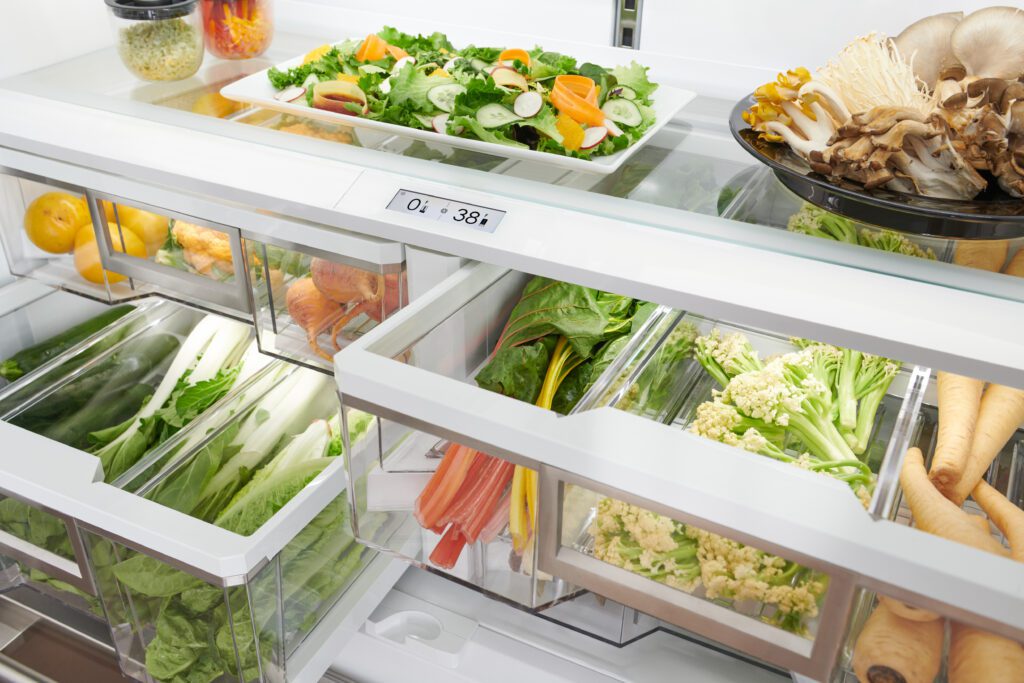
Crisper drawers (high humidity): Set to maximum humidity for leafy greens, herbs, and delicate vegetables. Coriander, mint, lettuce, spinach – anything that wilts in dry air – belongs here. Sub-Zero’s adjustable humidity controls allow you to keep this zone at 80-90% moisture, preventing dehydration.
Chefs do not guess at placement. They know which zone each ingredient requires and put it there deliberately. A Sub-Zero makes this possible because the temperature gradient is consistent and predictable.
Visibility is Half the Battle
In professional kitchens, nothing is stored in opaque containers unless absolutely necessary. The reason is simple: if you cannot see it, you forget it exists. And if you forget it exists, it spoils.
Chefs use clear glass or transparent containers exclusively. Stocks go into clear containers, labelled with masking tape and a marker showing the date and contents. Sauces, dressings, and prepared components sit in glass jars or squeeze bottles where the contents are immediately visible. Even marinating proteins are stored in clear zip-lock bags or glass dishes so you can see the state of the marinade and the meat without opening anything.
This extends to produce. Leafy greens are washed, dried, and stored in clear containers lined with paper towels to absorb excess moisture. Herbs are trimmed, placed in jars with a small amount of water (like a bouquet), and covered loosely with a plastic bag. Both methods keep ingredients visible and in optimal condition.
The principle is ruthlessly pragmatic: you cannot use what you cannot see. Visibility reduces waste. It also speeds up cooking. When you open the refrigerator and immediately identify what you have, meal planning becomes trivial.

FIFO: First In, First Out
Every professional kitchen operates on the FIFO principle. Older ingredients get used before newer ones. This is not a suggestion. It is a rule.
At home, this translates into a simple habit: when you buy new ingredients, place them behind existing ones. The yoghurt you bought yesterday sits at the front. The one you bought today goes behind it. Same with vegetables, dairy, proteins. Oldest items always come forward.
This requires discipline. It is easier to shove new groceries wherever they fit. But the payoff is significant. FIFO prevents that moment where you discover a forgotten container of curd that expired a week ago sitting behind the fresh one you just opened.
In a Sub-Zero, where food genuinely lasts longer, FIFO becomes even more important. The refrigerator will preserve ingredients well past the point where a standard fridge would have let them spoil. But that does not mean you should leave them indefinitely. Rotate stock. Use what you have. Keep things moving.
The Chef’s Refrigerator Layout (Adapted for Home)
Here is how a professional chef would typically organise a Sub-Zero built-in refrigerator for home use:
Top shelf (coldest zone):
Raw proteins for immediate use. Fresh fish. Meat for tonight’s dinner. Anything highly perishable.
Second shelf:
Prepared components. Stocks, sauces, dressings. Pre-portioned mise en place. Marinating proteins.
Third shelf:
Dairy and eggs. Fresh milk, yoghurt, paneer, cream. These sit at eye level for easy access but do not need the coldest zone.
Lower shelves:
Longer-term storage. Large containers. Bulk purchases. Ingredients for later in the week.
Door shelves:
Condiments, butter, soft cheeses, pickles, preserves. Items that benefit from slightly warmer temperatures.
Crisper drawers (high humidity):
Leafy greens, fresh herbs, delicate vegetables. Coriander, mint, lettuce, spinach.
Crisper drawers (low humidity, if dual-zone):
Root vegetables, peppers, citrus. Anything that prefers drier conditions.
This layout is not rigid. It adapts to what you are cooking that week. But the principles – zone by use case, respect temperature differences, maintain visibility, follow FIFO – remain constant.

What This Actually Accomplishes
The benefit of organising like a chef is not aesthetic. It is operational. When your refrigerator is organised by workflow, cooking becomes faster. You spend less time searching for ingredients. Meal planning becomes easier because you can see exactly what you have and what needs to be used. Waste drops to near-zero because nothing gets forgotten or buried.
A Sub-Zero makes this kind of organisation possible because it provides the infrastructure. The temperature zones are predictable. The humidity controls are adjustable. The shelving is configurable. The environment is stable enough that you can trust ingredients to stay exactly where and how you left them.
Professional habits, applied at home, with professional-grade equipment. That is the point.
| Experience Sub-Zero Refrigeration
Sub-Zero’s built-in and freestanding refrigerators are designed to support professional-level organisation. Adjustable zones. Configurable shelving. Precision temperature control. Built for kitchens where organisation and performance matter. Explore the full Sub-Zero refrigeration range → subzero-wolf.co.in/refrigeration-products/ |


