

The Experts Sub-Zero Asked Before It Built Anything New
Most companies that believe in their own engineering stop asking questions once they are confident they have the right answer. Sub-Zero took the opposite approach at a moment when it had every reason to be confident. It had spent decades perfecting dual refrigeration, and the system worked beautifully. Rather than assume that success meant the thinking was finished, the company went looking for people whose job was to find the flaw it might have missed.
That decision is a better explanation of what Sub-Zero actually is than any list of features, and it is worth telling properly.
A Question Asked of People Who Owed Them Nothing
When Sub-Zero began developing its next generation of refrigeration products, by its own account the company consulted with the experts. It asked a think-tank group at the University of Wisconsin whether they could help, and it consulted with post-harvest experts at the world-renowned University of California, Davis.
These were not marketing partners. A post-harvest specialist at a leading agricultural research university has no reason to be generous toward a refrigerator manufacturer. Their work is to understand, with total indifference to any brand, exactly how produce decays after it leaves the ground, and what does or does not slow that process. Asking that kind of expert to examine your product is asking for an honest answer, including an unwelcome one.

An Answer the Company Could Have Been Satisfied With
The verdict came back in Sub-Zero’s favour. All concluded that the existing dual refrigeration system worked beautifully. For most companies, that would have been the end of the conversation, a validated product and an easy story to tell.
Sub-Zero did not treat it that way. The same conversation continued. When the company discussed a new air purification system it was developing, the experts did not simply approve what already existed. They encouraged Sub-Zero to pursue it. The praise for the current system became the starting point for a harder question: given that the refrigeration already worked this well, was there something further worth building.
Borrowing From Further Afield Than a Kitchen
What Sub-Zero built in response did not come from anywhere near a kitchen. The air purification system draws on NASA-adapted technology, a lineage the company is explicit about. It takes the air inside the closed refrigerator cavity and passes it through a cartridge containing a small UV light and pipettes coated in titanium dioxide, where it acts as a catalytic converter, eliminating bacteria, fungus, odour, and ethylene gas with no residue. The company’s own description of this is understated and precise: it is proven technology that is used by many others.
That borrowing, from a space agency to a kitchen appliance, only makes sense once you understand the question that preceded it. Sub-Zero was not trying to add a feature to a list. It was told its refrigeration already worked beautifully, and it still went looking outside its own industry for a better answer to how food decays.
Why This Matters More Than the Technology Itself
It would be easy to tell this story as a list of specifications, a UV lamp, a titanium dioxide coating, a named university. But the detail worth keeping is the sequence of events. Sub-Zero did not invent a technology and then search for experts to endorse it after the fact. It asked the experts first, accepted a genuinely favourable verdict on what it had already built, and then used that same conversation to ask whether more was possible.
This is the same instinct that runs through the rest of the company’s history. Since 1945, the stated strategy has been to build the best, highest quality refrigeration, and every major advance since, dual refrigeration, built-in refrigeration, the disappearing design, wine preservation, has followed the same pattern: identify what is genuinely possible, not merely what is marketable, and build toward that.
What You Are Actually Buying
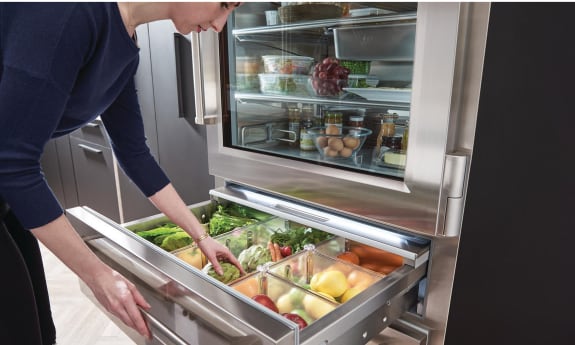
When a Sub-Zero refrigerator keeps coriander vivid for a week or lets a piece of fish taste clean days after you bought it, the explanation usually offered is the engineering, the dual systems, the purification cartridge, the controlled humidity. All of that is true. But underneath it is a working method: outside experts, consulted honestly, answered without flattery, and a company willing to keep asking questions after it had already been told it was doing well.
That is a harder thing to manufacture than a cartridge, and it is the real reason the cartridge works as well as it does.
Understanding It Properly, in Person
The engineering behind this is worth seeing rather than reading about, the cartridge itself, how it sits in the refrigeration cavity, and how the system fits into the rest of a Sub-Zero kitchen. A conversation with the Sub-Zero Wolf India team in Mumbai is where that becomes tangible, alongside everything else the range has to offer.
The company was told its refrigeration already worked beautifully, and it kept asking anyway. That is worth understanding properly before you decide what belongs in your own kitchen.
| See the Engineering in Person
Book an appointment with the Sub-Zero Wolf India team in Mumbai to see the air purification system and the rest of the refrigeration range, and understand the thinking behind them. Book a specification consultation: sales@subzero.co.in Varde Villa, Bandra West, Mumbai · subzero-wolf.co.in/contact-us/
Disclaimer:The performance and longevity of Sub-Zero and Wolf products may vary based on environmental conditions, water quality, and the availability of skilled personnel. The information provided in our blogs is based on ideal conditions. We strongly recommend that installation and maintenance be performed by official Sub-Zero and Wolf trained professionals and in strict accordance with Sub-Zero and Wolf guidelines to ensure optimal performance. The manufacturer and author are not responsible for variations in product performance due to local operating, environmental factors or non-compliance with recommended installation practices. |


