

You’ve done everything right. You bought the freshest coriander from the market, brought home a generous bunch of methi, and stocked up on curry leaves from your trusted vendor. By the next morning, the coriander is yellowing at the edges. By day three, the methi has wilted into something unrecognisable.
This is not a storage problem. It is a refrigeration problem.
The Indian kitchen is a world of extraordinary ingredients – delicate herbs, moisture-rich vegetables, dairy that demands precision, and a pantry that shifts with every season. What most refrigerators offer is a blunt, one-size-fits-all environment: a box that gets cold and stays cold. What Sub-Zero offers is something categorically different: a living, breathing ecosystem engineered around the science of freshness.
Here is what is actually happening inside a Sub-Zero – and why it changes everything about how your food looks, tastes, and lasts.
The Problem with Ordinary Refrigeration
A conventional refrigerator operates on a single-compressor system. This means one motor is responsible for both the refrigerator and freezer sections simultaneously – cycling on and off, pulling humidity out of the air each time it does. The result is a dry, inconsistent internal environment that accelerates the very process it is supposed to prevent: spoilage.
In India, where ambient temperatures can push above 40°C and kitchen humidity swings dramatically between seasons, the demands on a refrigerator are significant. A fridge that cannot maintain a stable internal climate is fighting a losing battle – and so is the food inside it.
Dual Refrigeration: Two Systems, One Purpose
At the heart of every Sub-Zero refrigerator is a patented dual refrigeration system – the feature that separates it from virtually everything else on the market.
Rather than sharing one compressor and one set of coils between the refrigerator and freezer, Sub-Zero uses two entirely separate systems: one dedicated exclusively to the refrigerator compartment, and one dedicated exclusively to the freezer. They never share air. They never share humidity. They never interfere with each other.
Why does this matter? Because the refrigerator and freezer have fundamentally different needs. The freezer demands dry, sub-zero air. The refrigerator needs cool, moist air to keep produce supple and fresh. In a single-compressor system, these two environments are always compromising each other. In a Sub-Zero, each compartment gets exactly what it needs – without exception.
The result is a refrigerator section that maintains far more consistent temperature and humidity – which directly translates to longer-lasting food.
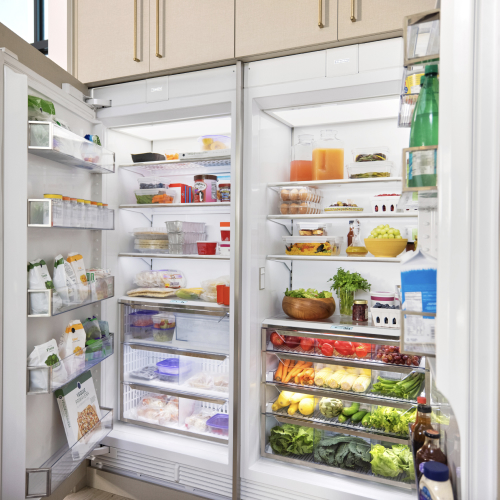
Micro-Humidity Control and What It Means for Your Indian Produce
Indian cooking is built on ingredients that are, by nature, highly perishable. Consider for a moment the variety that moves through an Indian kitchen in a single week:
- Coriander and mint – delicate herbs that begin to yellow within 24 hours in a standard fridge
- Curry leaves – prone to drying out and losing their essential oils rapidly when exposed to low humidity
- Methi (fenugreek leaves) – one of the most moisture-sensitive greens in the Indian kitchen
- Green chillies – which wrinkle and soften when humidity drops below their ideal range
- Root vegetables like carrots, beetroot, and radish – which need different moisture levels from leafy greens
Sub-Zero’s microprocessor-controlled environment monitors and adjusts conditions continuously, keeping the refrigerator section within a precise temperature band of 34°F–38°F (1°C–3°C) – the optimal range for most fresh produce. The dedicated crisper drawers further allow for humidity customisation, letting you create high-humidity zones for leafy herbs and lower-humidity zones for root vegetables.
The difference is not subtle. Coriander that would typically last two days in a standard refrigerator regularly lasts seven to ten days in a Sub-Zero. Curry leaves retain their colour and fragrance. Methi stays vibrant. The produce you buy at the weekend market can genuinely still be at its best by the following weekend.
| Did You Know?
Studies on food waste in India estimate that households discard between 20–30% of fresh produce each week due to inadequate storage. A Sub-Zero refrigerator’s precision environment can dramatically reduce this number – not just saving money, but reducing the environmental footprint of food waste. |
Air Purification: The Feature No One Talks About – But Everyone Benefits From
There is a silent war happening inside most refrigerators, and it is being waged by ethylene gas.
Ethylene is a naturally occurring gas that fruits and some vegetables emit as they ripen. In an enclosed space, ethylene accelerates the ripening and eventual spoilage of everything around it. Place a ripe mango next to your salad greens, and that ethylene will cause your greens to wilt and yellow far faster than they should. This is why so many kitchens play the constant game of trying to separate produce – a game that is impossible to win in a standard refrigerator.
Sub-Zero addresses this with a built-in air purification system that actively scrubs the internal atmosphere. Using activated carbon filtration and a magnetic door seal that eliminates air infiltration, it captures and neutralises ethylene gas, odours, mould, and bacteria before they can affect your food.
For the Indian kitchen, this is particularly meaningful. The aromas of a refrigerator stocked with spiced leftovers, marinating meats, or pungent cheeses can overwhelm and affect the flavour of delicate ingredients stored nearby. Sub-Zero’s purification system keeps the internal environment clean, neutral, and biologically controlled – so your masala chai ingredients taste only of themselves, and nothing else.
Three Technologies, One Outcome: Food That Lasts
It helps to think of a Sub-Zero not as a refrigerator, but as a preservation system. Three core technologies work in concert:
1. Dual Refrigeration
Two independent cooling systems ensure the refrigerator and freezer never compromise each other’s environment. Stable temperatures. Stable humidity. No cross-contamination of air.
2. Microprocessor Control
Sensors continuously monitor the internal environment and make micro-adjustments invisibly and constantly. The temperature you set is the temperature you get – not an approximation of it.
3. NASA-Inspired Air Purification
Developed using technology adapted from NASA’s space programme, Sub-Zero’s air purification system eliminates ethylene gas, mould spores, bacteria, and odours continuously – keeping the internal atmosphere as clean at day 14 as it was at day one.

A Different Relationship with Your Kitchen
There is something quietly transformative about opening a refrigerator and finding everything exactly as you left it – or better. The coriander still green and fragrant. The leftovers from last night’s dinner still at their peak. The seasonal mangoes ripening at exactly the pace you want them to.
When your refrigerator does its job with this level of precision, your relationship with food changes. You stop buying smaller quantities out of habit-based anxiety. You start cooking more adventurously, knowing that expensive or hard-to-find ingredients will still be in excellent condition when you need them. You stop discovering wilted herbs and questionable leftovers that have to be thrown away.
This is the quiet luxury of a Sub-Zero: not a statement of excess, but a fundamental upgrade in how your kitchen functions, day after day.
| Experience Sub-Zero Refrigeration
Sub-Zero’s range of refrigerators – from the iconic Classic series to the seamlessly integrated Designer and PRO collections – are built around one commitment: keeping your food at its absolute best, for as long as possible. |


