
What You Need to Know
The island has become the centre of gravity in the modern home. It is where guests gather, where children do homework, where conversation flows while dinner comes together. Placing a Wolf rangetop at its heart turns that social centre into a genuine cooking stage, the cook facing the room rather than a wall.
It is a beautiful idea. It is also a decision that demands real planning. An island rangetop introduces challenges that a wall-mounted setup never has to consider, and getting these wrong is expensive to fix once cabinetry is built and stone is cut.
Here is what actually matters when you build an island around a Wolf rangetop, drawn from the realities of how these kitchens come together.
Ventilation Is the First Conversation, Not the Last
Most people fall in love with the look of an island cooktop and treat ventilation as an afterthought. This is backwards. With an island, ventilation is the single hardest problem to solve, and it shapes every other decision you make.
A wall-mounted rangetop has an easy path for ducting: straight back, through the wall, outside. An island sits in open space, often with nothing above it but ceiling and nothing behind it but more room. The smoke, grease, and aroma that Indian cooking generates in abundance have to be captured and removed without that convenient wall to hide the ductwork.
Wolf offers two distinct answers. An island hood, suspended from the ceiling above the cooktop, is the traditional solution. It captures rising heat and smoke effectively and becomes a striking design feature in its own right. The alternative is downdraft ventilation, which rises from behind the cooktop when needed and pulls smoke downward and out, then disappears when the cooking is done. Downdraft keeps sightlines clean and the ceiling uninterrupted, which many designers prefer for open-plan spaces.
The choice is not purely aesthetic. Indian cooking produces more smoke and stronger aromas than the Western cooking these systems were originally designed around. Heavy tempering, deep frying, and high-heat searing demand serious extraction. Whichever route you choose, the system has to be specified for the kind of cooking you actually do, not the occasional pasta night the brochure imagines.

The Ductwork Decision Happens Before Anything Else
Here is the trap. The island looks finished on the floor plan, the cabinetry is approved, and then someone asks where the ducting will run. By that point, the answer is often “nowhere good.”
Ducting from an island has to travel either up through the ceiling or down through the floor and out. Both routes need to be planned at the structural stage, long before tiles go down or false ceilings go up. In Indian apartments, where slab penetrations may be restricted and floor routing is rarely possible, the ceiling path usually wins, and that means coordinating with whoever controls the building’s exterior and the false ceiling design from the very beginning.
The lesson is simple: decide the ventilation route before you fall in love with the island layout. Retrofitting a duct path into a finished kitchen means tearing things apart. Planning it early costs nothing but a conversation.
Bringing Services to the Middle of the Room
A wall cooktop has gas and power waiting in the wall behind it. An island has none of that. Every service the rangetop needs has to be routed to a spot in the middle of the floor, which means planning happens at the slab and screed stage, not when the cabinets arrive.
A Wolf gas rangetop needs a properly sized gas line run to the island, ideally with a shut-off valve that is reachable but concealed. The igniters and controls need electrical supply. If you are pairing the rangetop with anything else in the island, those services stack up quickly. The cleanest installations route all of this through the floor before the island base is built, so nothing is visible and nothing is improvised later.
This is where an experienced kitchen designer earns their fee. Coordinating gas, electrical, and ventilation routing into a single island, all hidden, all to code, is not a job to leave to chance or to a contractor seeing a Wolf rangetop for the first time.
Give the Cooktop Room to Breathe
A rangetop dropped into the centre of an island with no surrounding counter is a frustrating place to cook. You need landing space on both sides, somewhere to set a hot pan, rest a spoon, or stage the next ingredient. Without it, every cooking session becomes a scramble.
Generous counter to either side of the burners is not a luxury, it is what makes the island usable. Equally, the surface immediately around a Wolf rangetop takes heat and the occasional splash, so the material has to cope. Natural stone and engineered quartz both handle this well. The point is to choose a surface that looks beautiful and survives daily contact with high heat, rather than one that stains or scorches the first time a kadai comes off the flame.
The Seating Question Nobody Thinks Through
The appeal of an island rangetop is often social: the cook faces guests seated across the counter, conversation flowing while dinner happens. It is a lovely picture, until you consider what sits between cook and guests.
Open flames, spitting oil, and hot pans do not belong directly across from where someone is resting their elbows. Seating placed too close to the burners is a safety problem and an uncomfortable one, with guests flinching from heat and the occasional splatter. The workable solution is usually a split-level island, with the cooking surface on one tier and seating on a separate, slightly raised or offset tier that puts a buffer of counter and a change of height between flame and faces.
This is worth modelling carefully before committing. The fantasy of cooking face-to-face with guests is real and achievable, but only if the layout keeps people clear of the working heat.
Where Everything Else Goes
Putting the rangetop in the island changes the geometry of the whole kitchen. The classic triangle between cooking, washing, and cold storage now has one of its points floating in the middle of the room, and the other two need to relate to it sensibly.
The sink and the Sub-Zero refrigeration ideally sit within an easy turn or a couple of steps of the island, so the flow of carrying ingredients to the heat and finished dishes away from it stays natural. If the rangetop is on the island, think about whether prep happens there too, or whether a separate prep zone keeps the cooking surface clear. Wolf built-in ovens are usually best placed in a tall run along the perimeter rather than buried in the island base, where bending into a low oven beneath a cooktop is awkward and the heat sources compete.
There is no single correct layout. There is only the layout that matches how you move through a meal. Mapping that movement honestly, before the design is locked, is what separates a kitchen that photographs well from one that actually cooks well.
Letting the Rangetop Be the Statement
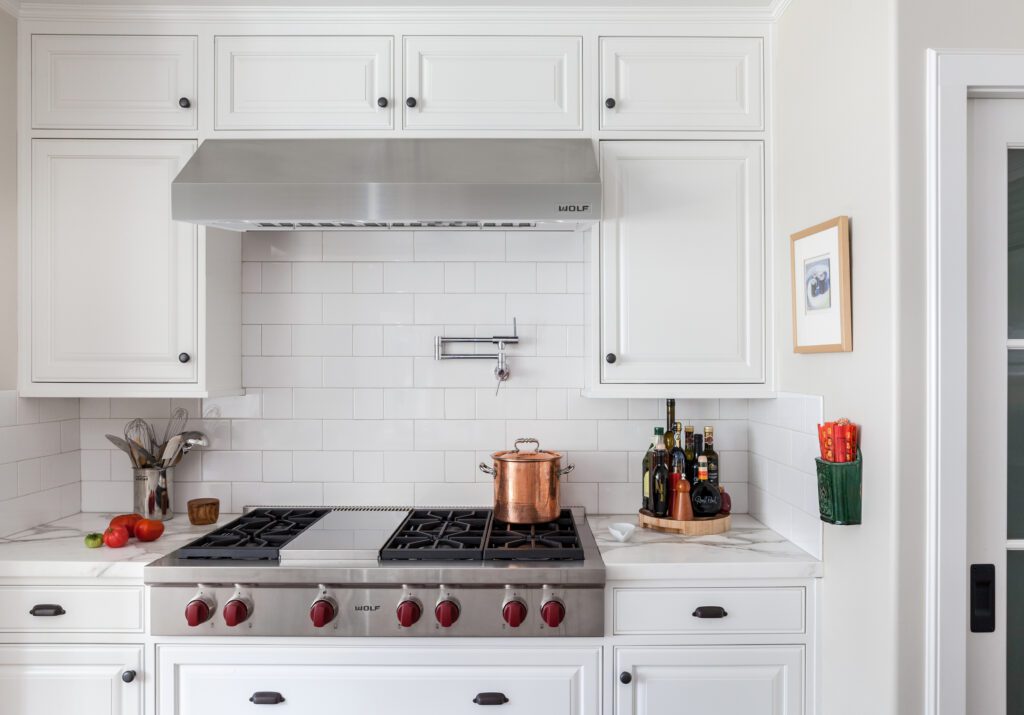
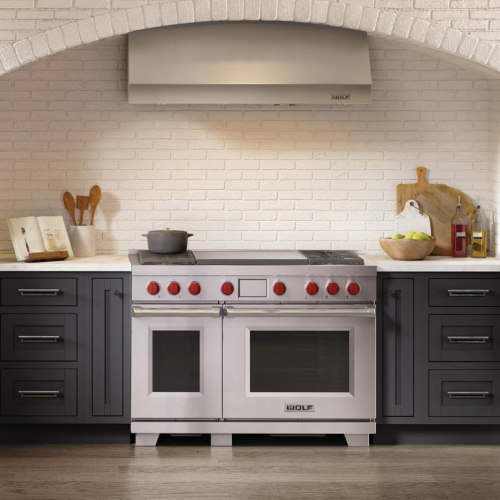
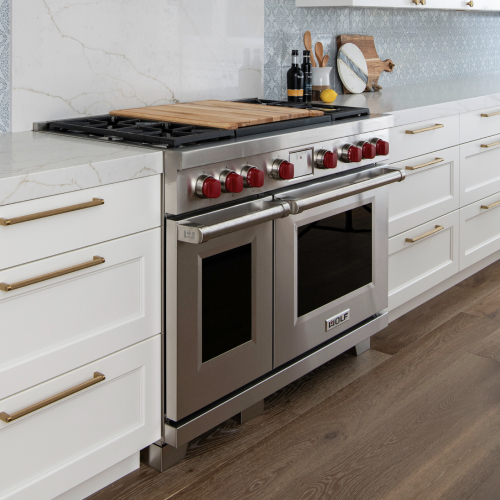
A Wolf rangetop is a striking object. The signature knobs, available in the iconic red or in black and stainless, are part of the brand’s visual identity, and an island puts them on full display from every angle in the room. This is an opportunity, not a problem.
When the rangetop is going to be seen in the round, the surrounding design should frame it rather than fight it. A restrained island, clean cabinetry, and a considered choice of knob colour against the worktop let the cooktop read as the deliberate centrepiece it is. Pair it with coordinating Wolf and Sub-Zero pieces around the room and the whole kitchen speaks one visual language, which is exactly the harmony these two brands are built to create together.
Plan the Invisible Before the Beautiful
An island built around a Wolf rangetop can be the most rewarding kitchen you will ever cook in. The cook stops facing a wall and starts facing the life of the home. But that reward depends entirely on the unglamorous work done early: the ventilation route, the hidden services, the clearances, the flow.
Get those right, before the first cabinet is built, and everything visible falls into place. Get them wrong, and you spend years working around problems that a single early conversation could have solved.
Design the parts no one sees first. The beautiful kitchen is what is left when you do.
| Design Your Kitchen with Wolf
Wolf rangetops, ventilation, and built-in ovens are designed to work together and coordinate seamlessly with Sub-Zero refrigeration. Plan your island around professional performance and cohesive design. Explore Wolf rangetops and ventilation → subzero-wolf.co.in/sealed-burner-range-top/ |


