

Why Temperature and Humidity Control Matter More Than You Think
You paid ₹8,000 for that bottle of Bordeaux. You stored it carefully – away from light, lying on its side, exactly as the sommelier recommended. Six months later, when you finally uncork it for a special dinner, the wine tastes dull. Flat. The complexity you expected is nowhere to be found. The bottle is not faulty. The problem is India.
Wine is not designed for India’s climate. And unless you are storing it in an environment that actively compensates for that fact, your collection is aging badly.
In a country where summer temperatures routinely exceed 40°C and humidity swings wildly between seasons, wine faces conditions it was never meant to endure. The delicate chemical reactions that develop complexity in a bottle – the evolution of tannins, the integration of acids, the slow oxidation that brings out secondary flavours – all of this depends on stability. Consistent temperature. Controlled humidity. Minimal vibration. Darkness.
A standard refrigerator cannot provide this. A kitchen cabinet certainly cannot. A wine rack in your living room is actively damaging your collection. This is why serious wine collectors in India – and increasingly, anyone who buys wine with the intention of keeping it for more than a few weeks – invest in dedicated wine storage.
Here is what is actually happening to your wine in India, and why Sub-Zero’s wine storage technology addresses problems most people do not even know exist.
The Temperature Problem: Why 25°C is Ruining Your Wine
Wine’s ideal storage temperature is between 12°C and 15°C. This is not arbitrary. At this temperature range, wine ages slowly and predictably. The chemical processes that develop flavour and character proceed at a pace that allows the wine to evolve without degrading.
In most Indian homes, ambient temperature sits between 25°C and 35°C for much of the year. At 25°C, wine ages approximately twice as fast as it would at 15°C. At 30°C, it ages even faster. This is not just accelerated aging – it is bad aging. The wine develops cooked flavours. The fruit character flattens. The balance between acid, tannin, and alcohol shifts in ways that make the wine taste tired and dull.
Worse still is temperature fluctuation. A bottle that experiences daily swings of even 5-7°C – which is typical in an air-conditioned home where the AC cycles on and off – undergoes expansion and contraction. The wine pushes against the cork. Air seeps in. Oxidation accelerates. This is why wines stored in Indian homes often develop off-notes within months, even if they were meant to age for years.
Sub-Zero wine storage units maintain a rock-solid temperature, typically set between 12°C and 15°C depending on the wine type. The compressor and insulation are engineered to prevent fluctuation – not just keeping the average temperature low, but ensuring it never deviates by more than half a degree. This kind of precision is what allows a ₹15,000 Barolo to develop into what it was meant to become, rather than degrading into an expensive disappointment.

Humidity: The Silent Destroyer of Corks (and Wine)
Most people focus on temperature and ignore humidity. This is a mistake. The cork is the weakest link in wine storage, and it behaves very differently depending on the moisture in the air around it.
Cork is a natural material designed to be slightly porous. It allows microscopic amounts of oxygen to reach the wine, which is necessary for aging. But if the environment is too dry – below 50% humidity – the cork begins to shrink and dry out. It loses its seal. Air infiltrates the bottle. What was supposed to be slow, controlled oxidation becomes rapid spoilage.
In an air-conditioned home in India, humidity often drops to 30-40%. A standard refrigerator, with its dehumidifying compressor cycle, can drop to 20% or lower. Both environments are terrible for wine. Within six months, corks in these conditions begin to shrink noticeably. Within a year, you can often see gaps between the cork and the bottle neck. By this point, the wine is already compromised.
Conversely, if humidity is too high – above 80% – labels deteriorate, mould can develop, and while the cork stays moist, the storage environment itself becomes a problem, particularly if you are storing wine long-term.
Sub-Zero wine storage units maintain humidity between 50% and 70%, the range that keeps corks supple and intact without causing secondary issues. The system monitors and adjusts continuously, compensating for India’s seasonal extremes. During the monsoon, it prevents excessive moisture. During the dry months, it ensures corks do not dry out. This is not a feature most people think about until they uncork a bottle and find the cork crumbling or the wine oxidised.
Vibration and Light: The Factors You Cannot See (But Your Wine Can)
Wine is a living liquid. The sediment in aged red wines is not debris – it is tannins, pigments, and proteins that have bonded together and precipitated out of solution over time. This is a natural part of aging. But it only happens properly if the wine is left undisturbed.
Vibration – from a compressor, from a washing machine in the next room, from traffic on the street – agitates the wine. It prevents sediment from settling. It can even disrupt the slow chemical reactions that develop complexity. This is why wine cellars are typically built in basements or quiet corners of homes. And it is why storing wine on top of a refrigerator, next to a speaker, or anywhere with regular movement is a terrible idea.
Sub-Zero wine storage units use a specially designed compressor mounting system that isolates vibration. The compressor operates on dampeners that absorb movement before it can reach the bottles. The shelves themselves are designed to cradle bottles securely without allowing them to rattle or shift. The result is an environment as still as a traditional wine cellar.
Then there is light. UV radiation from sunlight breaks down the compounds in wine that give it colour, aroma, and flavour. This is why wine bottles are tinted – darker glass filters more UV. But tinted glass is not enough if the bottle is exposed to direct or even indirect sunlight for hours every day.
Sub-Zero wine units use UV-resistant glass doors, and many models feature interior LED lighting that emits no UV radiation. The wine is protected from light degradation while still being visible – a consideration that matters if you have spent time building a collection you actually want to see and access.
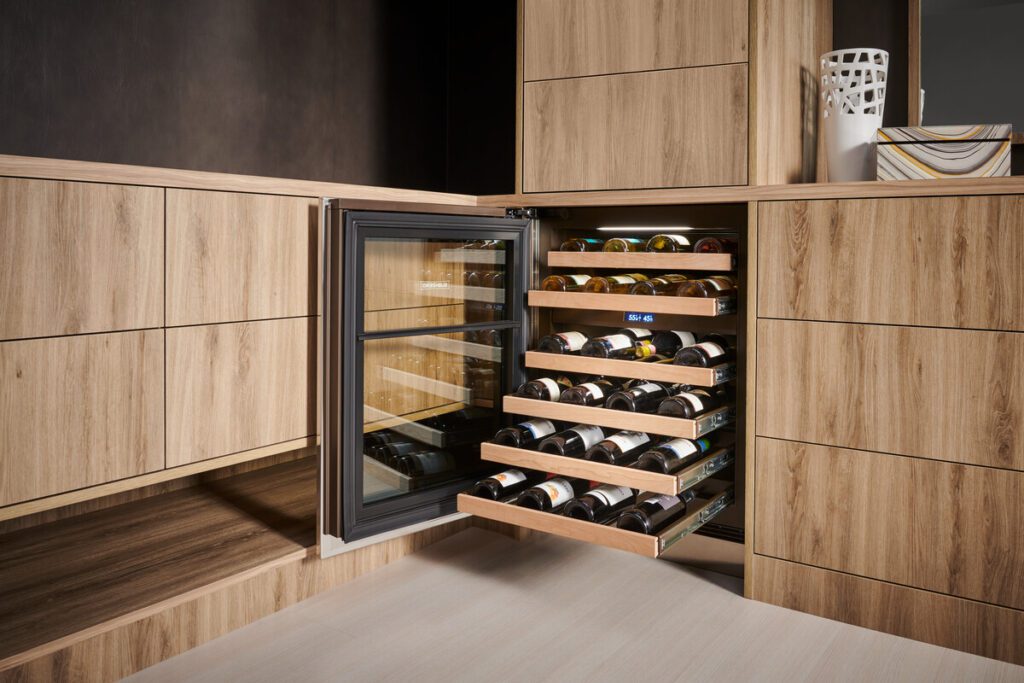
Dual-Zone Storage: Because Not All Wine is the Same
If you only drink one type of wine, a single-zone storage unit works fine. But most collectors – or even casual enthusiasts – own a mix. Reds. Whites. Sparkling wines. Dessert wines. Each category has a different ideal storage and serving temperature.
Red wines age best at 12°C-15°C and are typically served at 16°C-18°C. White wines and rosés prefer cooler storage, around 10°C-12°C, and are served chilled at 8°C-10°C. Sparkling wines need even colder conditions – 6°C-8°C for storage and serving.
A single-zone unit forces you to compromise. Set it at 13°C, and your reds are fine but your whites are too warm. Set it at 10°C, and your whites are good but your reds are too cold. The solution is dual-zone storage.
Sub-Zero’s dual-zone wine storage units allow you to set two entirely independent temperature zones within the same appliance. One section can hold reds at 14°C while the other keeps whites and sparkling wines at 8°C. Each zone is independently controlled and insulated, so the two temperatures never interfere with each other.
This is not just about storage. It is about serving wine correctly. When you pull a bottle from a dual-zone unit, it is already at the right temperature. No waiting. No ice buckets. No guesswork. This is the kind of functionality that separates a wine fridge from a serious wine storage system.
The Real Cost of Improper Storage
Here is a scenario that plays out in homes across India. Someone buys a case of wine – twelve bottles at ₹5,000 each. Total investment: ₹60,000. They store the bottles in a kitchen cabinet or a standard refrigerator. Six months later, half the bottles are past their prime. A year later, most are undrinkable. The financial loss is ₹40,000-₹50,000.
Or consider a collector who buys investment-grade wines – bottles meant to appreciate in value over five or ten years. A 2015 Bordeaux purchased for ₹12,000 today might be worth ₹25,000 in 2030, if stored correctly. If stored poorly, it is worth nothing. The wine degrades. The investment evaporates.
A Sub-Zero wine storage unit is not cheap. A 46-bottle dual-zone unit starts at several lakhs. But for anyone spending ₹50,000 or more per year on wine – which is not uncommon among enthusiasts – the unit pays for itself in prevented spoilage within two to three years. Beyond that, it is pure protection of value.
This is before you account for the intangible cost: the disappointment of opening a special bottle for an important occasion and discovering it has gone bad. There is no financial metric for that, but anyone who has experienced it knows how frustrating it is.
| What About a Regular Wine Fridge?
Budget wine fridges exist, and some work adequately for short-term storage of everyday drinking wines. But they have limitations. Most lack humidity control, relying on passive moisture retention. Temperature stability is inconsistent – swings of 2-3°C are common. Vibration dampening is minimal. And build quality often means the unit fails within three to five years. A Sub-Zero wine storage unit is engineered to last decades, with replaceable components and service support. It is built for collectors who view wine storage as a long-term commitment, not a temporary solution. |
Building a Home Wine Cellar in India: What Works
If you have the space, a dedicated wine cellar remains the gold standard. But in urban India – where real estate is expensive and most homes lack basements – a traditional cellar is not practical. This is where Sub-Zero’s wine storage units become essential.
Sub-Zero offers both built-in and freestanding wine storage options, ranging from compact 24-bottle units to large-capacity systems holding 200+ bottles. Built-in units integrate seamlessly into kitchen cabinetry or custom millwork, creating a cellar-like environment without requiring a separate room. Freestanding units can be placed in a dining room, study, or even a walk-in closet.
The key is understanding your collection and how you plan to grow it. If you currently own 30 bottles but intend to expand, starting with a 46-bottle dual-zone unit gives you room to grow while maintaining proper storage for what you have now. If you are a serious collector with 100+ bottles, a larger built-in system makes sense.
Location matters. Wine storage units should be installed away from direct sunlight, heat sources like ovens or radiators, and high-traffic areas where vibration is common. A quiet corner of a living room, a dedicated bar area, or a climate-controlled storage room are all good options.

Wine Deserves Better Than India’s Climate Can Offer
Wine is an investment – financially, culturally, and experientially. Whether you are collecting Burgundy for long-term appreciation or simply keeping a few bottles of everyday wine on hand, storage conditions determine whether that investment pays off or deteriorates.
India’s climate is unforgiving. Without precise temperature control, stable humidity, vibration isolation, and UV protection, wine degrades. A ₹10,000 bottle becomes ordinary. A collection built over years loses its value. A dinner party ends in disappointment.
Sub-Zero wine storage units exist because wine demands conditions that normal refrigeration cannot provide. They are not a luxury. They are the baseline for anyone serious about wine in a country where the climate works against you from day one.
This is how wine survives India. And this is how a collection becomes something worth keeping.
| Explore Sub-Zero Wine Storage
Sub-Zero’s wine storage collection includes dual-zone units, built-in systems, and freestanding options designed for serious collectors and everyday enthusiasts alike. Precision engineering. Decades of reliability. Built for India’s demanding climate. View the full Sub-Zero wine storage range → subzero-wolf.co.in/wine-storage/ |


