

A Guide to Cooking Methods Most People Never Use
You own a Wolf Convection Steam Oven. You use it to reheat leftovers and occasionally steam vegetables. Meanwhile, the oven is capable of sous vide cooking, proving bread dough, baking with bakery-quality crusts, and slow-roasting meat to restaurant precision. You have a professional tool being used as a microwave substitute.
This is not unusual. The convection steam oven is Wolf’s most underutilized appliance – not because it is complicated, but because most people do not understand what combination cooking actually does or why it matters.
Here is a guide to the modes you are not using and the techniques that will change how you cook.
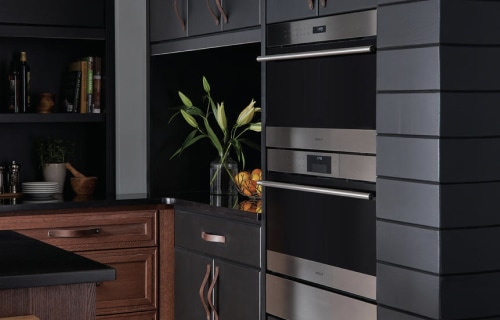
What Combination Cooking Actually Means
A standard oven uses dry heat. Steam penetrates food. Combination cooking uses both simultaneously, which produces results neither method can achieve alone.
Example: roasting a chicken. Dry heat alone creates a crispy skin but can dry out the meat. Steam alone keeps the meat moist but the skin stays pale and flabby. Combination cooking – convection heat for the skin, steam for moisture retention – produces a bird with crackling skin and meat that stays juicy all the way through.
The Wolf Convection Steam Oven automates this. It does not just add a bit of moisture. It actively manages the ratio of steam to dry heat throughout the cooking process, adjusting in real-time based on what the food needs.
Steam Baking: Why Bakeries Get Better Crusts Than You Do
Professional bakeries use steam-injected ovens. The burst of steam at the beginning of the bake delays crust formation, allowing the dough to expand fully before the exterior sets. This creates the thin, crackling crust and open crumb structure that defines artisan bread.
Your Wolf Convection Steam Oven replicates this. The Bread & Pastry mode introduces steam during the initial phase, then switches to dry convection heat to finish the crust. The result is bread that looks and tastes like it came from a professional bakery, baked at home.
This works for baguettes, sourdough boules, dinner rolls, croissants, and any laminated pastry. The steam keeps the dough pliable during oven spring (the rapid rise in the first few minutes of baking), which is what creates those dramatic splits and golden, shiny crusts.
How to use it: Place shaped dough in the oven. Select Bread & Pastry mode. Set temperature (typically 220°C-230°C for bread). The oven handles steam injection and timing automatically. No spray bottles. No ice cubes in a pan. The oven does it correctly.

Proof Mode: Bread Dough Rising on Schedule
Bread dough rises best at 24°C-28°C with moderate humidity. Too cold, and fermentation slows. Too warm, and the dough overproofs and collapses. Most kitchens fluctuate too much to provide consistent rising conditions, especially in India where ambient temperatures swing with the seasons.
Proof mode holds the oven cavity at exactly 38°C with controlled humidity, creating ideal conditions for yeast activity. This is not just for bread. It works for pizza dough, brioche, cinnamon rolls, and any yeasted pastry.
The practical benefit: timing becomes predictable. A dough that might take 2-4 hours to rise at room temperature (depending on kitchen warmth) will rise in 60-90 minutes in Proof mode, consistently. You can start dough in the morning, proof it while you run errands, and bake it exactly when you want it ready.
Sous Vide Without the Water Bath
Sous vide cooking – vacuum-sealing food and cooking it in a precisely controlled water bath – produces results ordinary cooking cannot match. A steak cooked sous vide at 54°C for two hours is medium-rare edge to edge, not just in the center. Salmon cooked at 50°C stays silky and custard-like. Chicken breast cooked at 63°C is impossibly tender.
The Wolf Convection Steam Oven includes Sous Vide mode, which uses steam to hold the oven cavity at precise temperatures from 32°C to 100°C, adjustable in 1-degree increments. You vacuum-seal the food (or use heavy-duty zip-lock bags with air pressed out), place it on a rack, and let the oven hold temperature for as long as needed.
No water bath. No immersion circulator. No risk of the bag floating or the water evaporating mid-cook. The oven maintains temperature as precisely as dedicated sous vide equipment, but with more capacity and less setup.
What this is good for: Steaks, chicken breasts, salmon, pork chops, lamb chops, egg bites, custards, and any protein where texture precision matters. Finish with a quick sear in a pan or under the broiler for crust.
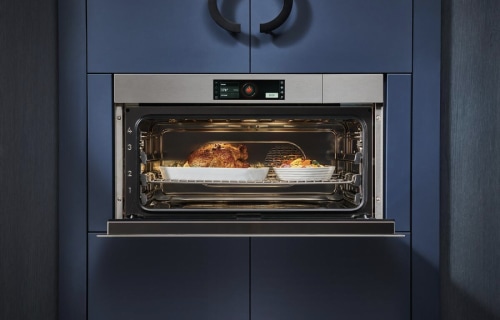
Convection Steam Mode: Crispy Outside, Juicy Inside
This is the mode that makes sense once you use it but sounds abstract when described. Convection Steam combines dry heat with periodic steam injection, creating an environment where the exterior of food browns and crisps while the interior stays moist.
Use cases: roast chicken, pork shoulder, beef brisket, whole fish, casseroles, gratins, baked pasta dishes. Anything where you want caramelization on the outside and moisture retention inside.
The oven alternates between convection heat (to drive browning and evaporation) and steam bursts (to prevent drying). The result is food that tastes roasted – with all the flavor development that implies – but without the dryness that typically comes with long roasting times.
This is particularly effective for Indian cooking. A tandoori-style chicken, marinated and cooked in Convection Steam mode, develops char and crust while staying moist inside. Biryani finished in the oven (after stovetop cooking) steams the rice to fluffy perfection while crisping the bottom layer.
Slow Roast Mode: Set It and Walk Away
Slow Roast mode is designed for large cuts of meat that benefit from low, slow cooking – lamb shanks, pork belly, beef short ribs, whole chicken. You insert the included temperature probe into the thickest part of the meat, select your desired final temperature (e.g., 63°C for medium-rare beef), and tell the oven what time you want it finished.
The oven calculates cooking time automatically, adjusts heat and steam levels as needed, and finishes exactly when you specified. If you want dinner ready at 7 PM, the oven works backwards from that deadline and starts cooking at the right time to hit your target.
This is not slow-cooker cooking. The texture is different – more roasted, less braised. The meat develops crust and caramelization while staying tender. It is closer to restaurant-style slow roasting than to home slow-cooker stews.
Reheat Mode: Leftovers That Taste Fresh
Most people reheat food in a microwave, which works by agitating water molecules. This is why microwaved food often tastes dried out or rubbery – moisture evaporates unevenly, and textures degrade.
Reheat mode uses a combination of steam and gentle convection heat to bring food back to temperature without drying it out. The steam replaces lost moisture. The convection heat warms evenly without creating hot spots.
The difference is dramatic. Day-old biryani, reheated in the oven, tastes nearly as good as it did fresh. Leftover roast chicken stays moist. Rice does not harden. Dal does not develop that reheated, stale flavor.
This also works for bread. A day-old baguette, wrapped in foil and reheated in steam mode for 5-7 minutes, comes out with a crisp crust and soft interior, nearly indistinguishable from fresh.
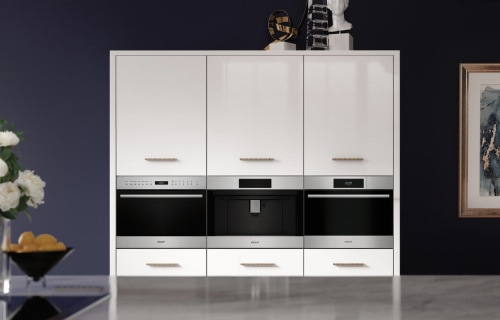
Gourmet Mode: Autopilot for Complex Dishes
Gourmet mode is Wolf’s attempt to make the oven self-managing. You select the type of food you are cooking – soufflé, crown roast, lasagna, sweet potatoes – and the oven uses its climate sensor to detect volume, shape, and consistency. It then adjusts temperature, steam levels, and timing automatically.
This is not for simple dishes. This is for recipes where timing and technique matter. A chocolate soufflé that needs precise heat to rise without collapsing. A crown roast that needs even cooking across different thicknesses. Gourmet mode removes guesswork.
It works well for people who cook ambitious dishes occasionally but do not have the repetition to develop muscle memory for timing. The oven compensates for inexperience with precision.
What You Are Missing If You Do Not Use These Modes
A Wolf Convection Steam Oven costs significantly more than a standard convection oven. If you are only using Convection mode and Reheat, you are paying for capabilities you are not accessing.
The techniques above – steam baking, sous vide, combination roasting, slow roasting with probe control – are not gimmicks. These are methods professional kitchens use daily. The Wolf oven brings them into a home kitchen without requiring commercial equipment or expertise.
The learning curve is not steep. Each mode is designed to simplify a technique that would otherwise require multiple steps, specialized tools, or precise timing. You are not learning to cook differently. You are letting the oven handle complexity so you can focus on ingredients and flavor.
Start with One Mode at a Time
If this feels overwhelming, pick one mode and use it until it becomes second nature. Bread & Pastry if you bake. Convection Steam if you roast. Sous Vide if you want restaurant-quality protein. Reheat if you cook in batches and eat leftovers throughout the week.
Once one mode becomes routine, add another. Within a few months, you will be using the oven the way it was designed to be used – not as a single-purpose appliance, but as a versatile tool that adapts to whatever you are cooking.
And when that happens, you will wonder how you ever cooked without it.
| Explore Wolf Convection Steam Ovens
Wolf Convection Steam Ovens combine steam, convection, and intelligent automation to deliver professional cooking techniques at home. Available in E Series, M Series, and Professional configurations. View the full Wolf oven range → subzero-wolf.co.in/convection-steam-oven/ |


