

How Professional Chefs Think About Heat – And What It Means for Your Home Kitchen
Watch a professional chef cook and you will notice something immediately: they adjust heat constantly. A pan goes from high to low to medium within seconds. Burners get turned off mid-recipe, then reignited moments later. Heat is not a setting. It is a tool they wield with precision.
Most home cooks treat heat as binary: on or off, high or low. This is not wrong, but it limits what you can do. Understanding how chefs think about heat – and having equipment that responds the way professional ranges do – changes everything about cooking.
Here is what that actually means in a home kitchen equipped with Wolf.

High Heat is Not Just About Speed
Wolf’s dual-stacked burners deliver up to 16 MJ of power. This is not marketing. This is the kind of output professional kitchens use for wok cooking, searing steaks, and bringing large pots of water to a rolling boil in minutes rather than waiting.
But high heat is not just about speed. It is about texture. When you sear a piece of meat over intense heat, the exterior caramelizes before the interior overcooks. This is the Maillard reaction – the browning that creates depth of flavor. It only happens above 140°C, and it happens faster and more completely when heat is aggressive.
A standard home range – even a good one – delivers 9-12 MJ on its highest burner. This is enough to cook, but not enough to sear properly. The pan heats slowly. The meat releases moisture before it browns. You get grey, steamed protein instead of a crust.
Wolf’s 16 MJ burner solves this. The pan gets screaming hot in 60 seconds. The steak hits the surface and sears immediately. The crust forms before the center temperature rises past medium-rare. This is not a luxury. This is the difference between mediocre and excellent.
Low Heat is Where Most Ranges Fail
High heat gets attention, but low heat is where Wolf’s dual-stacked burner design becomes invaluable. Most gas burners cannot hold a true simmer. Turn them down, and the flame either stutters unevenly or goes out. You end up with a burner set higher than you want because anything lower does not stay lit.
Wolf’s dual-stacked burners have two tiers of flame ports. At high settings, both tiers fire. At low settings, only the lower tier operates, delivering a tiny, stable flame capable of holding a pot just above a simmer without scorching.
This matters for: sauces that need to reduce slowly without breaking, chocolate that has to melt without seizing, rice that should steam gently without burning, stocks that simmer for hours without boiling over, and Indian cooking techniques like dum (slow cooking under a sealed lid) where steady, gentle heat is essential.
Chefs do not guess at heat levels. They set the exact flame they need and trust it to stay there. Wolf makes this possible at home.
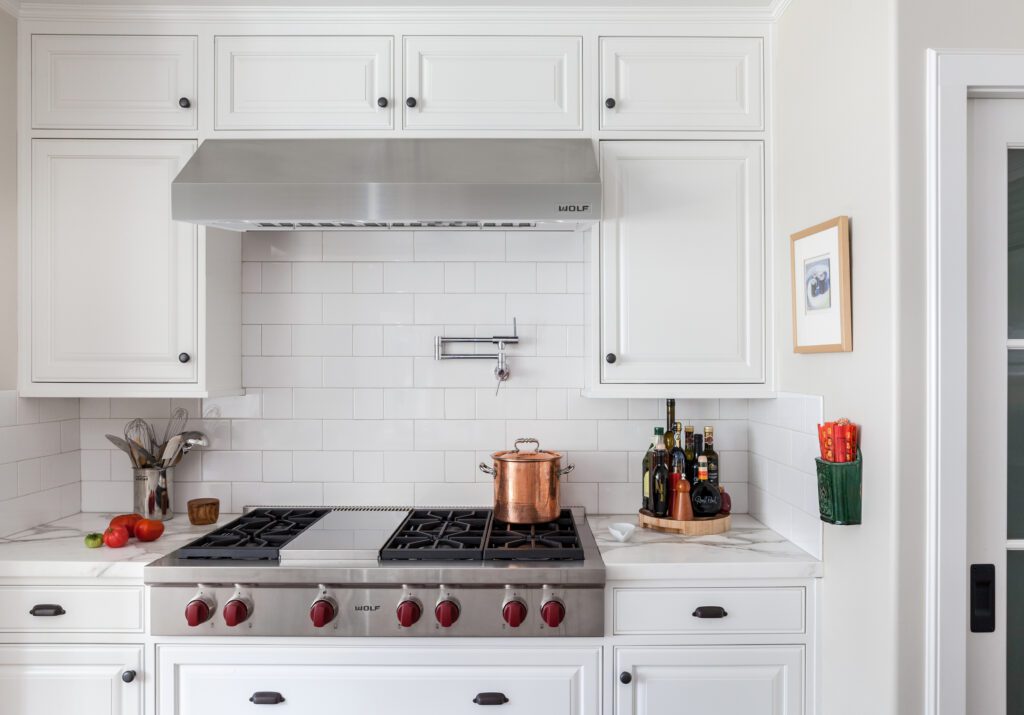
Instant Response: Why Gas Still Wins for Stovetop Control
Turn a Wolf gas burner from high to low, and the response is immediate. The flame drops. The pan cools within seconds. This is why professional kitchens overwhelmingly use gas for stovetop cooking – not tradition, but control.
Compare this to electric coil or even standard induction. Electric takes minutes to cool down. Induction is faster but still introduces lag. Gas responds instantly because the heat source itself changes the moment you adjust the knob.
In practice, this means: deglazing a pan the moment you remove the protein, reducing a sauce by dropping heat before it over-reduces, pulling a pot off boil the second pasta is done, catching caramelized onions before they burn, adjusting mid-technique without losing momentum.
This is not theoretical. This is the difference between cooking reactively and cooking with confidence.
Visual Feedback Changes How You Cook
One advantage gas has over induction: you can see the flame. This sounds trivial until you realize how much chefs rely on visual cues. A tall, roaring flame tells you the pan is getting maximum heat. A low, blue whisper tells you it is holding at simmer. You adjust based on what you see, not a digital display.
This becomes second nature quickly. Within weeks of cooking on a Wolf range, you stop thinking about heat settings numerically (“set it to medium-high”) and start thinking about it visually (“I want that flame about halfway up the burner”). The knob becomes an extension of your hand, adjusted constantly and unconsciously as the dish evolves.
What 16 MJ Actually Lets You Do
Here are techniques that require Wolf-level heat output and do not work reliably on standard ranges:
Wok cooking: Proper stir-frying requires intense heat that keeps ingredients moving and searing rather than steaming. Wolf’s wok burner option (available on select rangetops) delivers 10 kW specifically for this.
Searing multiple steaks: A heavy cast-iron pan loaded with four steaks pulls heat out of the burner rapidly. A weak burner cannot recover. A 16 MJ burner maintains temperature and keeps searing.
Rapid boiling for pasta: Bringing 5-6 liters of water to a rolling boil in under 10 minutes. Standard burners take 15-20 minutes.
High-heat Indian cooking: Techniques like bhuna (dry roasting spices and aromatics at high heat) or making dosa on a hot tava require sustained high heat that most home ranges cannot deliver.
These are not edge cases. For anyone cooking seriously, these are regular occurrences.

The Sealed Burner Advantage
Wolf’s burners sit within sealed drip pans. This is not just about easy cleaning (though that matters). Sealed burners direct heat upward toward the pan rather than allowing it to escape around the sides. This makes the burner more efficient – more of the heat you are generating actually reaches the food.
The sealed design also means spills and splatters stay contained. In professional kitchens, burners get wiped down between services. At home, sealed burners mean a quick wipe after cooking instead of scrubbing grates and cleaning underneath burner caps.
Heat is Not a Setting. It is a Conversation.
The difference between cooking on a Wolf range and cooking on a standard range is not just performance. It is the relationship you develop with heat.
On a standard range, you set heat and hope. You compensate for weak burners by cooking longer or moving pans around to find hot spots. You work around the equipment.
On a Wolf range, heat becomes predictable. You set it high, and it delivers high. You drop it to simmer, and it holds simmer. You adjust constantly because the range responds instantly. You stop thinking about the equipment and start thinking about the food.
This is what chefs mean when they talk about heat control. It is not about knowing the right temperature. It is about having equipment that does exactly what you ask, when you ask, every single time.
And once you have that, you cook differently. Not just better. Differently.
| Experience Wolf Cooking
Wolf ranges, rangetops, and cooktops deliver professional-level heat control for home kitchens. Dual-stacked burners. Instant response. Sealed design. Built for cooks who take heat seriously. Explore the full Wolf cooking range → subzero-wolf.co.in/cooking-products/ |


